 Skip to content
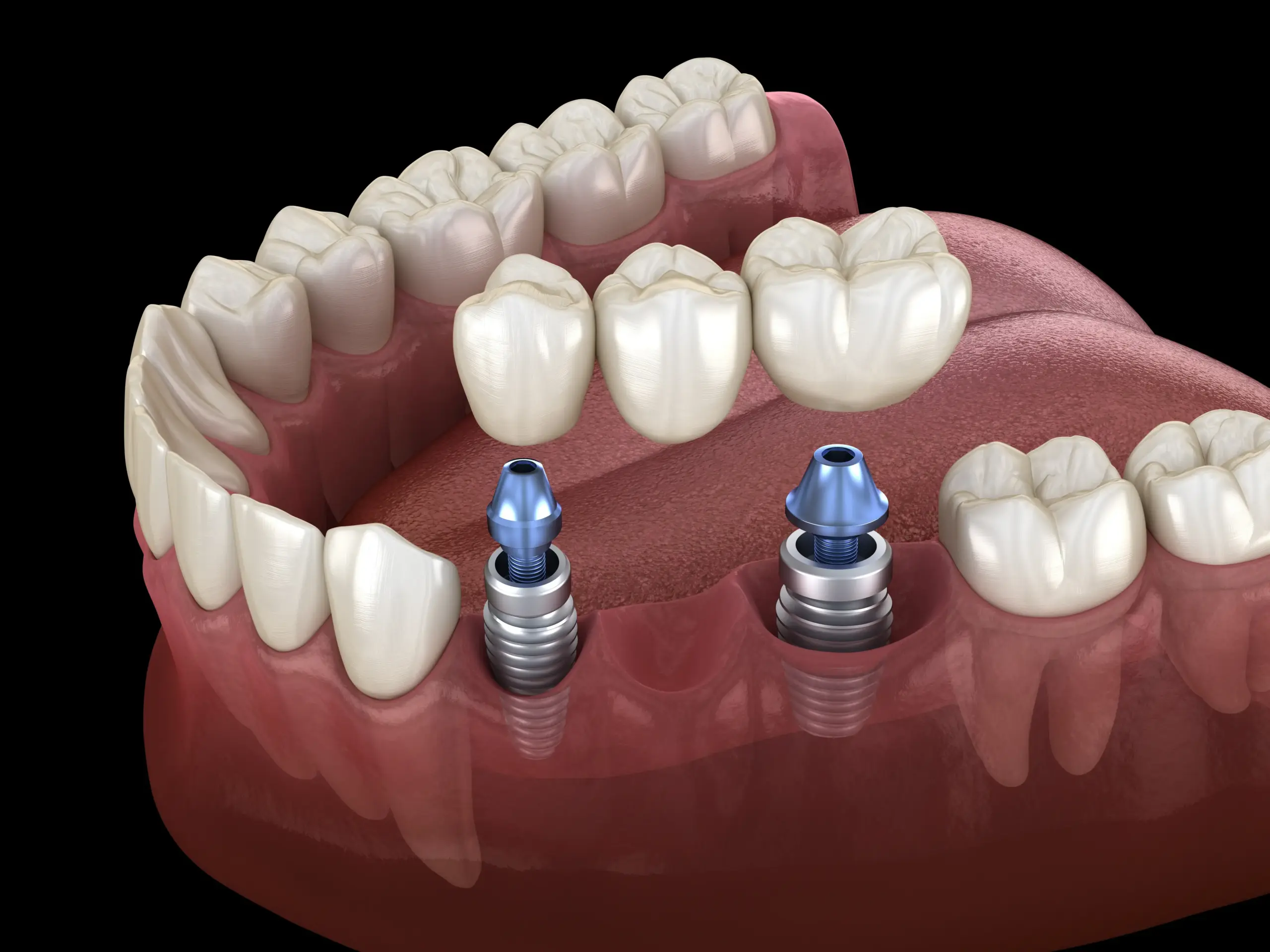
Table of Content
Dental Implants vs. Bridges – What Is Right for You?
By Dr. Kevin S. McCurry, MAGD, LVIF practicing at Whitney Plaza Dental- Sheridan, Wyoming.
If you’re missing a tooth (or several), you’ve probably heard that dental implants are the “gold standard.” And sometimes they truly are. But after 37 years in practice and more than three decades placing implants, I can tell you something that doesn’t always get said clearly enough:
The real answer is… it depends.
Choosing between an implant, a bridge, or another form of tooth replacement is not a one-size-fits-all decision. It’s more like real estate:
location, location, location—except in dentistry it also includes bite forces, bone, esthetics, health, habits, finances, and long-term goals.
Let’s walk through what really matters.
What Is a Dental Implant?
A dental implant is a titanium or titanium-alloy post placed into the jawbone to act as a replacement root. A crown is attached to the implant to replace the missing tooth.
Implants can be wonderful—but they are not just “drop-in teeth.” They must integrate into bone, handle chewing forces, stay bacteria-free, and fit into a healthy bite.
If any of those pieces are wrong, problems follow.
What Is a Dental Bridge?
A bridge replaces a missing tooth by anchoring to the teeth next to it. Those teeth are shaped and crowned, and a false tooth is suspended between them.
Bridges have been used successfully for over 100 years, and when done well, they can last decades.
They are:
- Less invasive than implants
- Faster
- Often far less expensive
- Predictable when the surrounding teeth are healthy
Sometimes a bridge is not just acceptable—it’s actually the better choice.
Why Implants Are Not Automatically “Better”
Implants are powerful tools—but they require the right conditions.
Here are some of the key factors I evaluate:
1. Bone and Anatomy
You must have enough bone in the right shape and location to support an implant. Sinuses, nerves, and thin jawbone all limit where implants can go safely.
That’s why a CBCT 3-D scan is essential before placing any implant. It allows us to see:
- Bone thickness and density
- Sinus location
- Nerve pathways
- Jaw anatomy
Placing implants without a CBCT is like flying blind.
2. Bite (Occlusion)
This is huge.
If your bite is off—even slightly—implants can fail, loosen, or fracture. Natural teeth have shock absorbers (ligaments). Implants do not. They are rigidly anchored into bone.
That means:
- Bite forces must be carefully balanced
- Grinding or clenching can be destructive
- A “heavy bite” can break screws, crowns, or implants
3. Esthetics
Front-tooth implants are especially tricky. Gum tissue and bone shrink after tooth loss. If the implant is placed poorly, you can get:
- Long or uneven crowns
- Dark triangles
- Gum recession
- Metal showing
A well-done bridge can sometimes look better than an implant in the esthetic zone.
4. Health and Habits
Implants are more likely to fail in patients with:
- Diabetes
- Autoimmune disease
- Smoking or vaping
- Acid reflux
- Night grinding
- Poor oral hygiene
These don’t automatically rule out implants—but they absolutely affect long-term success.
A Word About Screw-Retained Implants
I am not a fan of screw-retained abutments or crowns for most cases.
Why?
Because they can:
- Loosen or break
- Strip internally
- Trap bacteria
- Leak at the screw access hole
- Cause gum inflammation
They are not sealed systems. This is one reason I prefer locking-taper implant designs like Bicon, which create a cold-welded, bacteria-resistant seal.
The Problem With “All-On-X” Dentistry- BEWARE!
“All-on-4,” “All-on-6,” and similar systems are heavily marketed. They promise:
“A full set of teeth in a day.”
Sounds amazing- but here’s what most ads don’t show you.
These systems require:
- Large amounts of jawbone upper and lower usually needs to be ground away = Massive surgical trauma
- Implants placed at less-than-ideal angles
- A rigid bridge that cannot be removed by the patient
- Very difficult hygiene/ homecare- likely leading to implant failure over time failures
- Difficult and expensive repairs
- No flexibility if something breaks
- Very high cost
- Often irreversible
Once that bone is removed, you can never get it back.
If the bite is even slightly off, the system can fail catastrophically. Implants do not survive bad bites
These systems can work in selected cases- but they are frequently oversold because they are very profitable for clinics.
Patients should always get a second opinion before committing to this level of treatment.
Why Conventional Dentistry Still Matters
Bridges, partials, and well-designed crowns:
- Preserve bone
- Are less invasive
- Are often easier to clean
- Cost far less
- Can last decades
Dentistry existed long before implants- and it worked.
Sometimes the best solution is the one that is least destructive to your natural anatomy.
How We Decide What’s Right for You
In our office, we look at:
- 3-D CBCT imaging
- Bite analysis
- Bone health
- Esthetics
- Your medical history
- Your goals
- Your budget
Then we review:
- Implants
- Bridges
- Partials
- Or combinations
Our goal is not to sell you the most expensive solution, it’s to give you the most appropriate one.
Final Thought
Dental implants can be life-changing when done correctly in the right patient, for the right reason
But bigger, more expensive, and more surgery does not always mean better.
You only get one set of jaws. Choose wisely.
About Dr. Kevin S. McCurry
Dr. McCurry has practiced general dentistry for 37 years and has placed dental implants for over 33 years. He holds a Mastership (MAGD) in the Academy of General Dentistry—an honor achieved by less than 2% of dentists in North America—and is a Fellow of the Las Vegas Institute for Advanced Dental Studies, focusing on occlusion, airway, and complex restorative care.
References (for further reading)
- Misch CE. Contemporary Implant Dentistry, 4th ed. Elsevier.
- Stanford CM. Dental implant failure and peri-implant disease. Dent Clin North Am. 2015.
- Lang NP, et al. Risk factors in implant therapy. Clin Oral Implants Res.
- Pjetursson BE et al. Long-term survival of bridges vs implants. J Dent Res.
- Buser D et al. Esthetics and implant placement. Periodontology 2000


